This page will explain how to create realistic and aesthetically pleasing train consists using the JP+ NewGRFs.
Types of Consist
The two main types of train consist are locomotive-hauled and multiple units. Locomotive hauled trains are traditional trains with an engine or locomotive at the front, hauling unpowered wagons or coaches behind it. Multiple units do not have a distinct locomotive, instead they have their power units distributed across the train in various configurations.
Multiple units can be either diesel-powered (DMU) or electric powered (EMU). As so much of Japan’s rail network is electrified, most passenger trains in Japan are EMUs.
In the early days of electrification, multiple units have traditionally only been found on local and commuter trains, featuring high capacity but low speed. However, since the mid-20th century, multiple units began to dominate express trains as well. Locomotive-hauled passenger trains dwindled and now are only found on certain historical and luxury trains.
Like the rest of the world, the vast majority of freight trains in Japan are locomotive-hauled. This is advantageous because freight trains require flexibility and modularity. However, there is one exception; the M250 Cargo EMU which is a fixed consist that carries express freight in containers.
Multiple Units
MU (Multiple Unit) Wagons are a special type of wagon which adapts its appearance and properties to match the train unit that it’s attached to. This technique is used by the JP+ NewGRFs in different ways depending on the situation. It is an easy way to extend a multiple unit train without having to manually couple the units together.
Each NewGRF can only use its own MU wagon, which is why there are separate ones for the different JP+ NewGRFs. The following JP+ NewGRFs use MU wagons:
To build a train with MU wagons, first select a multiple unit. Then select the matching MU wagon, and build them until the train is the desired length.
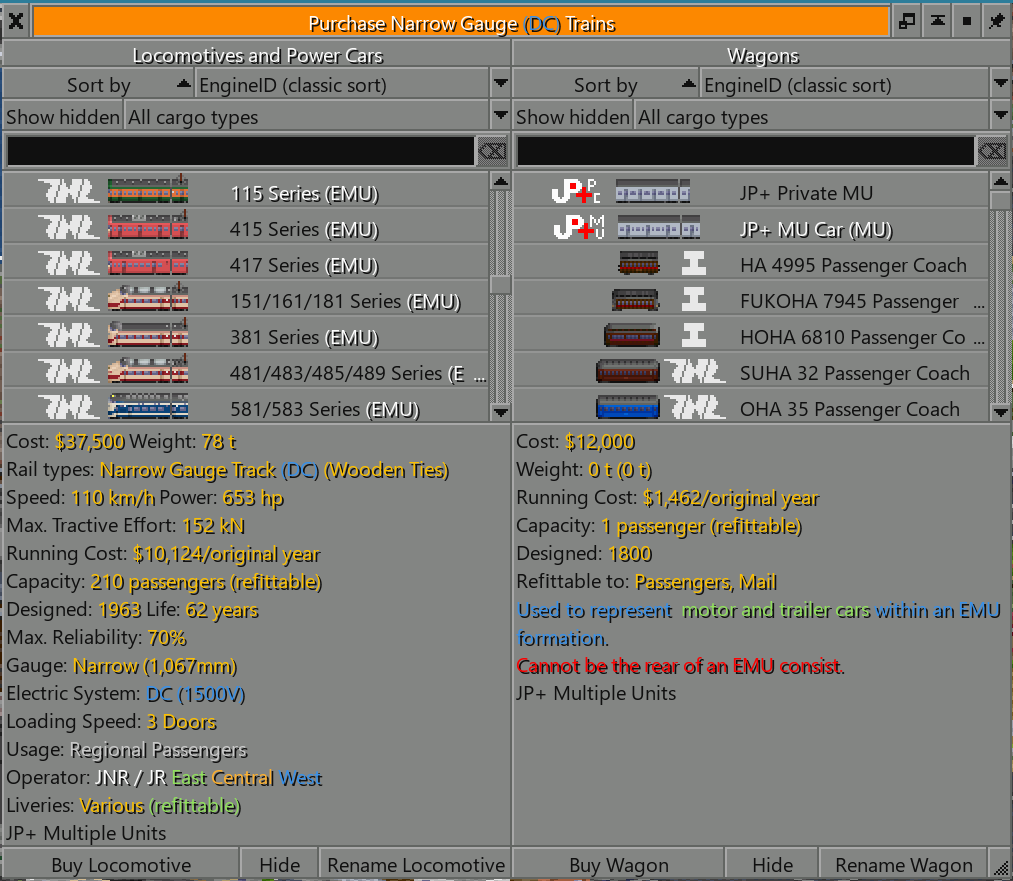
Hint:
Enable the OpenTTD setting
show the NewGRF's name in the build vehicle windowto ensure you select the correct matching MU wagon.
Here is the resulting train. The MU wagons have adapted the appearance and capacity of the leading unit. It looks OK but it is a bit monotonous for its length.

Let’s build two separate shorter trains of different lengths, and then combine them into a single long train. Not only does this break the train up visually, it is also more realistic, as these regional EMUs were often configured in shorter consists.

To customise your train further, such as changing the colour scheme, see Livery Refits.